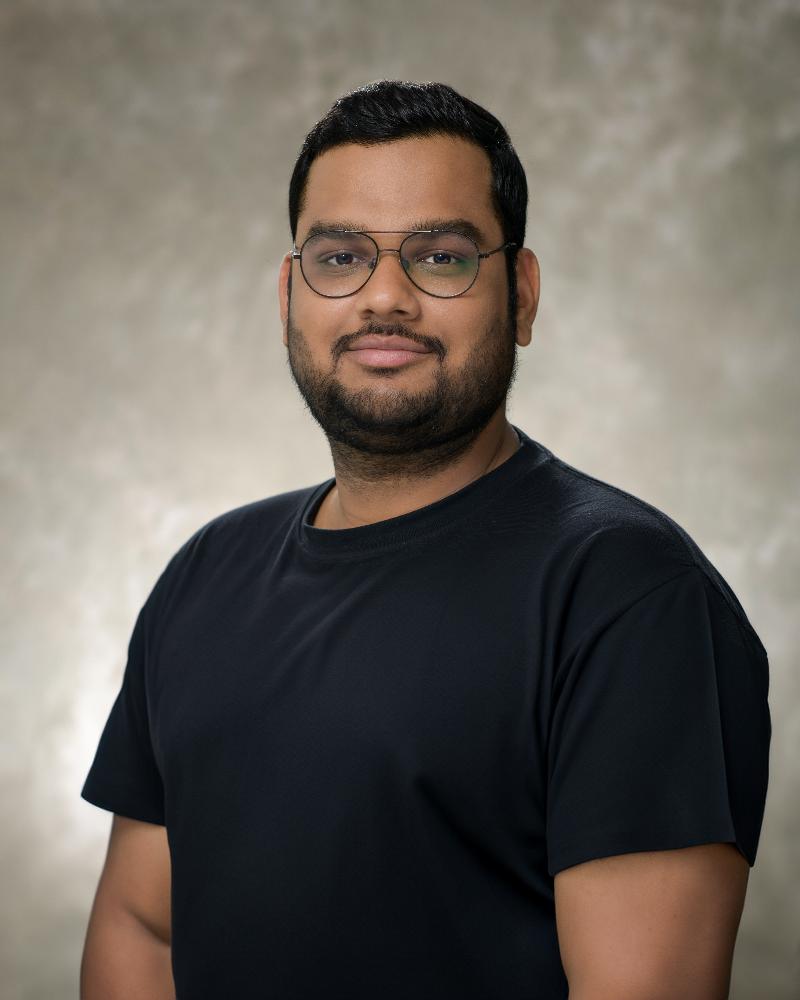
Master of Science Ayush Somani will hold the Trial Lecture and Thesis Defense for the PhD degree in Science on Wednesday, September 16, 2026.
Trial Lecture
The Trial Lecture will take place 10:15 - 11:15.
The title of the Trial Lecture is:
« Document page layout segmentation »
Thesis Defense
The Thesis Defense will take place 12:15 - 15:00.
The title of the thesis is:
« Interpretability as a Reliability Pipeline: From Diagnostic Explanations to Grounded Supervision in Deep Learning »
Abstract
Deep learning has achieved strong performance in biomedical and scientific imaging, yet its reliability remains difficult to assess under practical constraints such as limited supervision, heterogeneous acquisition settings, and risk-sensitive deployment. High benchmark accuracy can coexist with shortcut learning, brittle generalization under distribution shift, and explanations that appear convincing without being behaviorally connected to the model’s reasoning. This thesis addresses this gap by advancing interpretability as a reliability pipeline rather than a visualization task.
The thesis develops this view across four connected stages. First, it establishes diagnostic interpretability as a protocol for auditing model behavior, combining reliability-oriented synthesis of explanation methods with counterfactual verification in biomedical segmentation. Second, it introduces constraint-based reliability by embedding domain knowledge into learning objectives, including physics-guided virtual labeling for microscopy, where optical priors help prioritize meaningful foreground structures. Third, it stabilizes learning under label scarcity through a microscopy-adapted semi-supervised framework that combines consistency regularization, pseudo-label refinement, and blending strategies across heterogeneous imaging modalities and biological scales. Finally, the thesis advances grounded active explainability through frameworks that transform explanations into validated segment- and concept-level evidence. Explain with Confidence fuses multiple saliency maps using reliability indicators and grounds them through foundation segmentation models, while Segment-Concept Explanations connects influential segments to semantic concepts using vision-language models.
Across these contributions, the thesis applies a shared evaluation lens based on faithfulness, stability, robustness under shift, annotation and computational cost, and diagnostic utility. Overall, the thesis argues that interpretability becomes scientifically and practically valuable when explanations are made testable, bounded by explicit assumptions, and grounded in representations that support both reliable learning and human-centered auditing under limited supervision.
Supervisory Committee
- Professor Dilip K. Prasad, Department of Computer Science, UiT (Main Supervisor)
- Professor Alexander Horsch, Department of Computer Science, UiT
- Associate professor Chai Hiok Quek, Nanyang Technological University, Singapore
- Assistant Professor Dwarikanath Mahapatra, Khalifa University, Abu Dhabi
Evaluation Committee
- 1st Opponent: Professor Elisa H. Barney Smith, Department of Computer Science, Luleå University of Technology, Sweden
- 2nd Opponent: Professor (Artificial Intelligence) Swati Aggarwal, Faculty of Logistics, Molde University College, Norway
- Internal member and leader of the committee: Dr. Edvard Pedersen, Department of Computer Science, UiT, Norway
Streaming
The Trial Lecture and Thesis Defense will be streamed via Panopto:
Trial Lecture (10:15 - 11:15)
Watch the Trial Lecture
Thesis Defense (12:15 - 15:00)
Watch the Thesis Defense
Thesis
The thesis is available in Munin:
When: 16.09.26 kl 10.15–15.00
Where:
Store auditorium B302, Realfagbygget
Location / Campus: Digitalt, Tromsø
Zielgruppe: Ansatte, Studenter, Besøkende, Invited, Enhet
E-mail: daniels.sliks@uit.no